 Scientific
 Technological
— Yes, on Jupiter
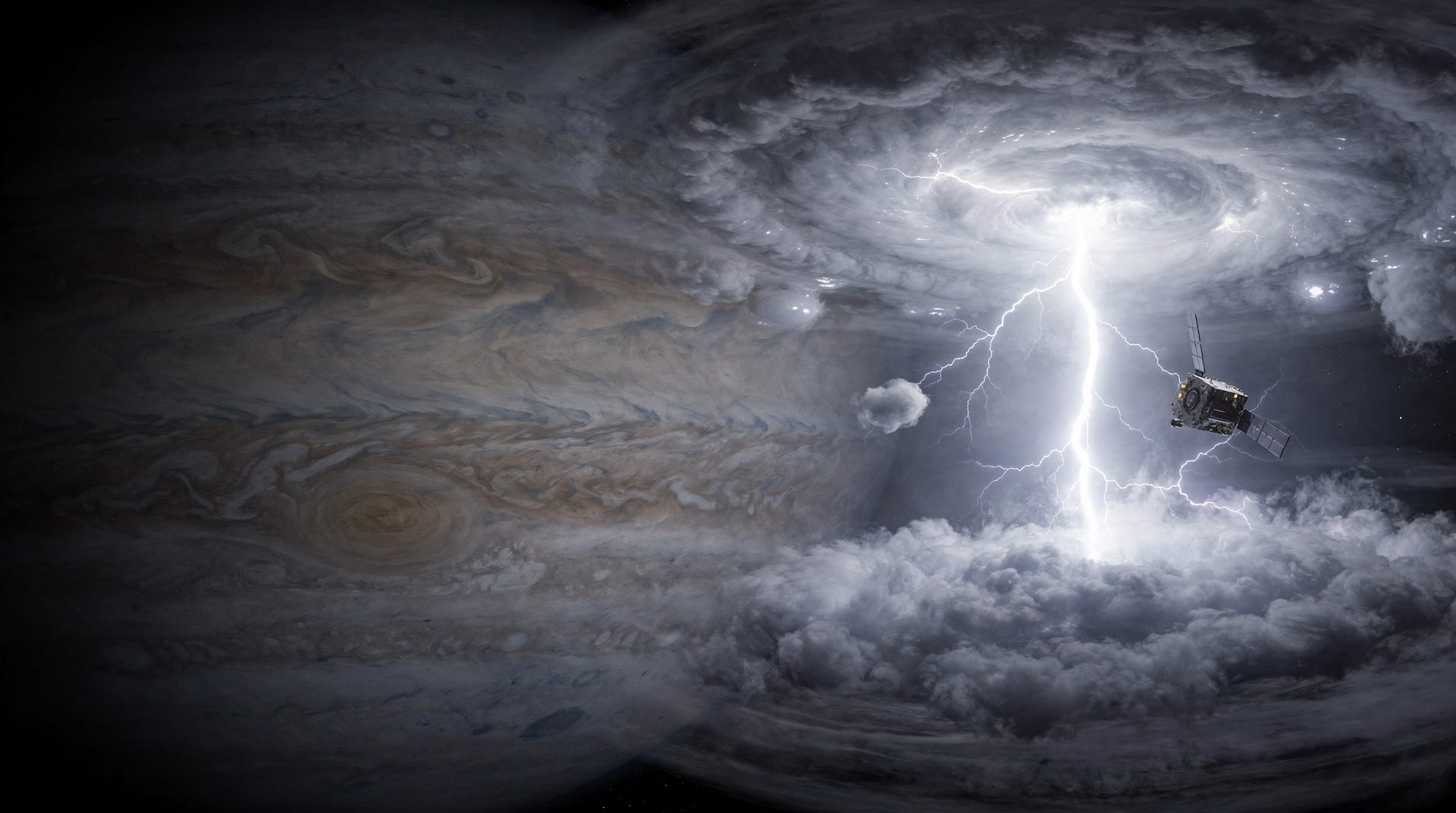
The power of lightning on this planet is so immense that the energy released is comparable to the regular detonation of nuclear warheads.Jupiter is covered in storms with intense lightning, but measuring their power has long been a technical challenge because of the gas giant’s dense atmosphere. As Science.org reports, a new study published in the journal AGU Advances found that individual electrical discharges on Jupiter are 100 to 10,000 times more energetic than their Earthly counterparts. The breakthrough was made possible by data from NASA’s Juno spacecraft. Later, the Juno mission provided more detailed data on lightning on Jupiter, confirming its existence and characteristics.
A typical lightning bolt on Earth releases about 1 billion joules of energy. Extreme Jovian lightning carries as much as 10 trillion joules. That is equivalent to 2,400 tons of TNT, or one-sixth the yield of the atomic bomb dropped on Hiroshima. Based on the frequency of flashes recorded by Juno, storms on the planet generate the force of several nuclear explosions every minute.
The Physics of an Alien Thunderstorm
Scientists believe that lightning on Jupiter and Earth forms in a similar way: friction between water vapor and ice particles in clouds creates an electric potential. The difference is that in Jupiter’s atmosphere, water combines with ammonia. This process produces distinctive hailstones that radically change the way charge builds up inside a storm. A study published in Nature Astronomy showed that lightning on Jupiter forms through mechanisms similar to those on Earth, including convection and cloud charging.
To gather data, Juno’s probe used a microwave radiometer. The instrument was originally designed to search for chemical compounds by detecting radio waves, but it also turned out to be capable of picking up radio emissions from lightning strikes. Because the planet has an enormous number of storms, the spacecraft had a hard time isolating specific discharges. Researchers took advantage of a period of relative weather calm and synchronized the radiometer data with images from Juno’s camera and observations from the Hubble Space Telescope. This made it possible to study four large storms, each up to 3,000 kilometers in diameter, where an average of three flashes per second was recorded.
A Catalyst for Life
According to Science.org, the researchers believe the estimated power of Jovian lightning may be too low. Electrical discharges of this scale release energy in many ways: not only in the radio and optical ranges that can be detected, but also through powerful thermal, acoustic, and chemical effects.
Extremely powerful lightning plays a key role in triggering and accelerating complex chemical reactions, with energies comparable to volcanic eruptions. The existence of life on Jupiter itself is highly unlikely because of the planet’s gaseous structure, but such extreme weather conditions demonstrate a mechanism for initiating prebiotic chemistry in space. Further study of these high-energy processes will depend on the status of the Juno mission, whose funding is currently being reviewed by NASA.
