 Scientific
 Philosophical
— As it turns out, yes
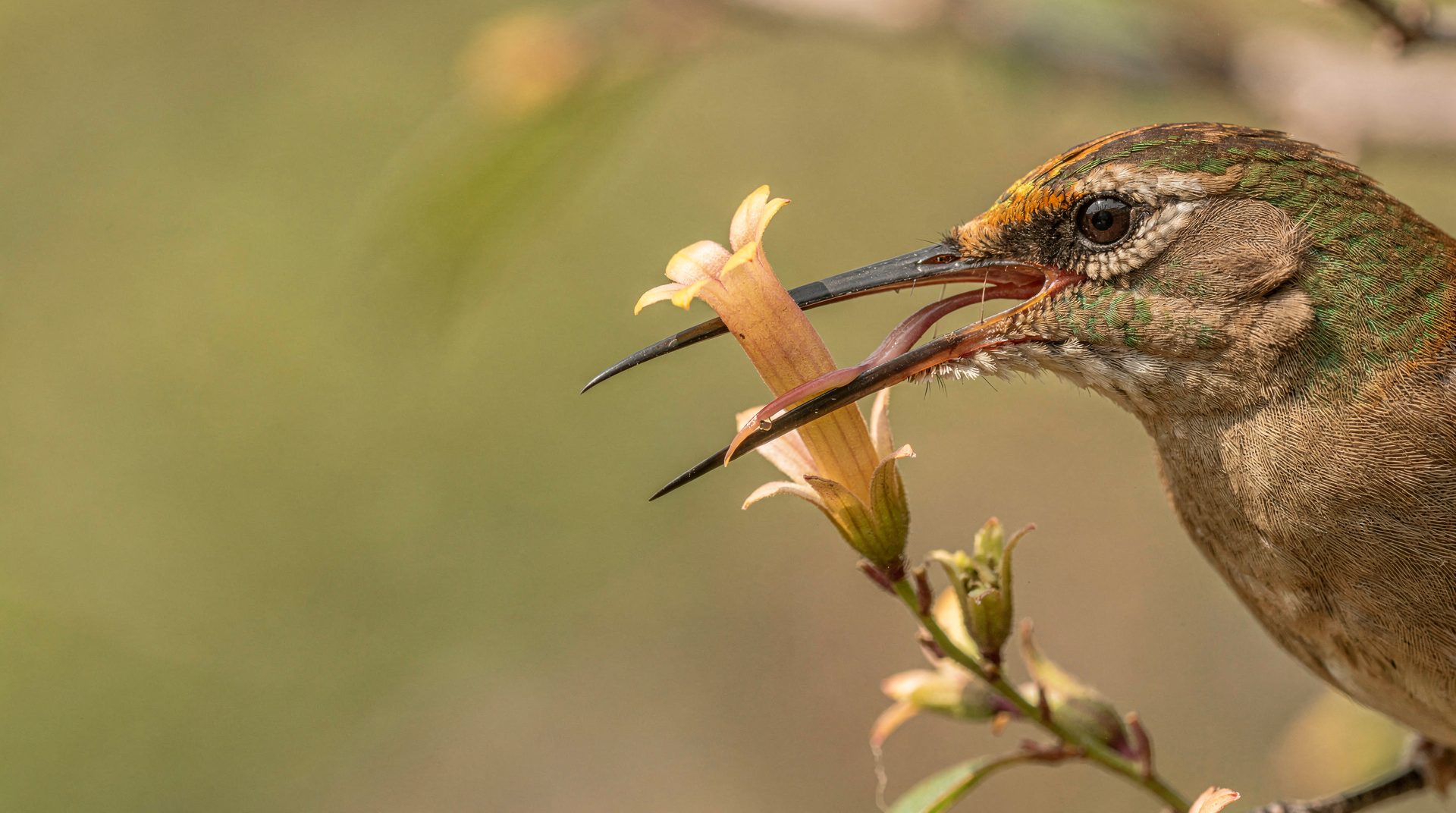
Biologists have discovered that sunbirds use their tongues as a vacuum mechanism to extract food.Many animals can draw in food: butterflies sip nectar, and walruses gulp down shellfish. Until recently, however, birds were thought to be incapable of doing the same. As Science.org reports, researchers have now documented for the first time a vertebrate’s ability to take in liquid through suction generated solely by tongue movements, without changing the shape of the mouth.
The Difference From Hummingbirds
Biologist David Kuban studied sunbirds — birds that, through convergent evolution, developed long, narrow beaks similar to those of hummingbirds. A 2019 study by Emily Jones and Michael Brown examines how convergent evolution led to similar adaptations in hummingbirds and sunbirds. Hummingbirds drink nectar by repeatedly sticking out their tongues and physically scraping them against the bill. A 2020 study by John Smith and colleagues describes in detail how hummingbirds use capillary action to draw nectar from flowers. To take a closer look at how sunbirds feed, the scientist recorded seven species of these birds with a high-speed camera. The birds were fed through artificial flowers 3D-printed in a shape that made it possible to observe fluid movement.
It turned out that, unlike hummingbirds, sunbirds dip their tongues into the flower only once. The bird does not close its bill or fully retract its tongue, but instead makes barely perceptible up-and-down movements while drinking continuously.
How the Process Works
According to Current Biology, this physical process is made possible by the bird’s specialized anatomy. Along the upper side of the sunbird’s tongue runs a V-shaped groove. When the tongue presses against the roof of the mouth, the groove compresses. As the tongue moves downward, space opens up between the bill and the groove, creating a pressure difference that generates suction and pulls nectar inward. Computer hydrodynamic modeling confirmed this mechanism and ruled out alternatives such as capillary action.
Studying the biomechanics of sunbird feeding helps biologists better understand how birds and flowering plants coevolve, and it sheds light on the fundamental physiological differences between sunbirds and other species.
